
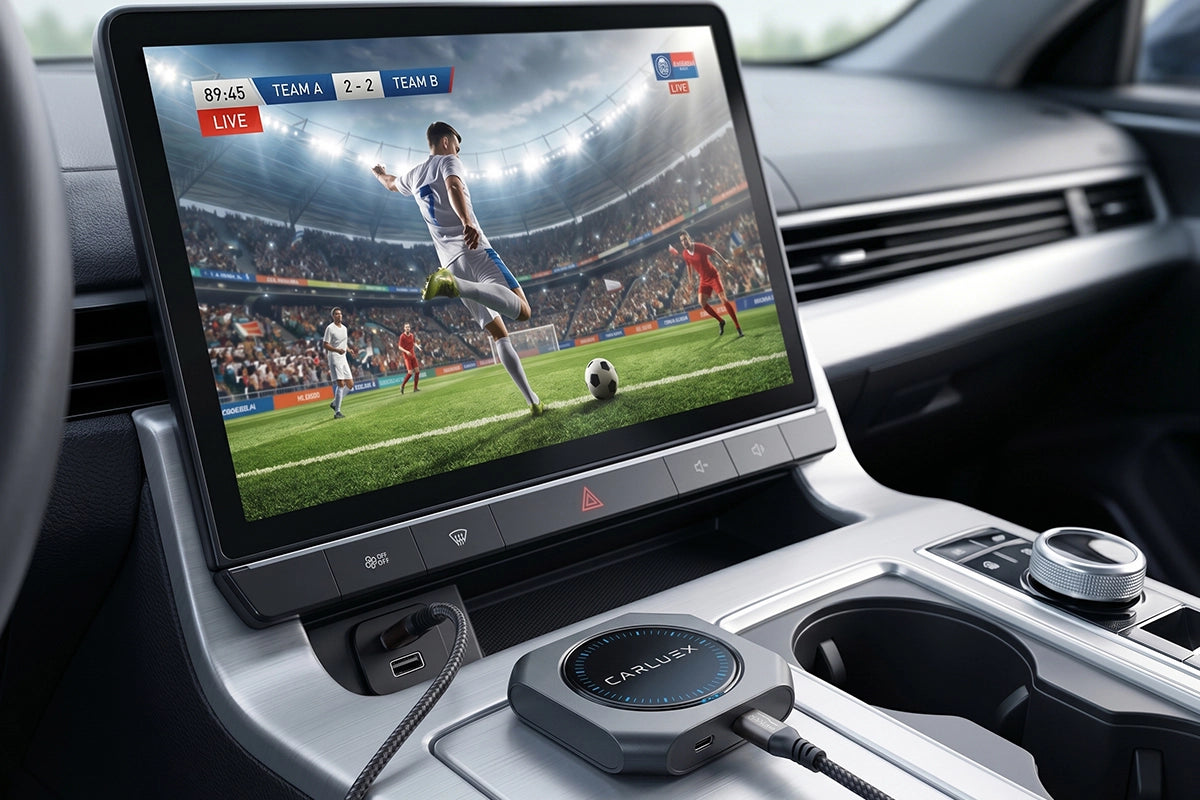
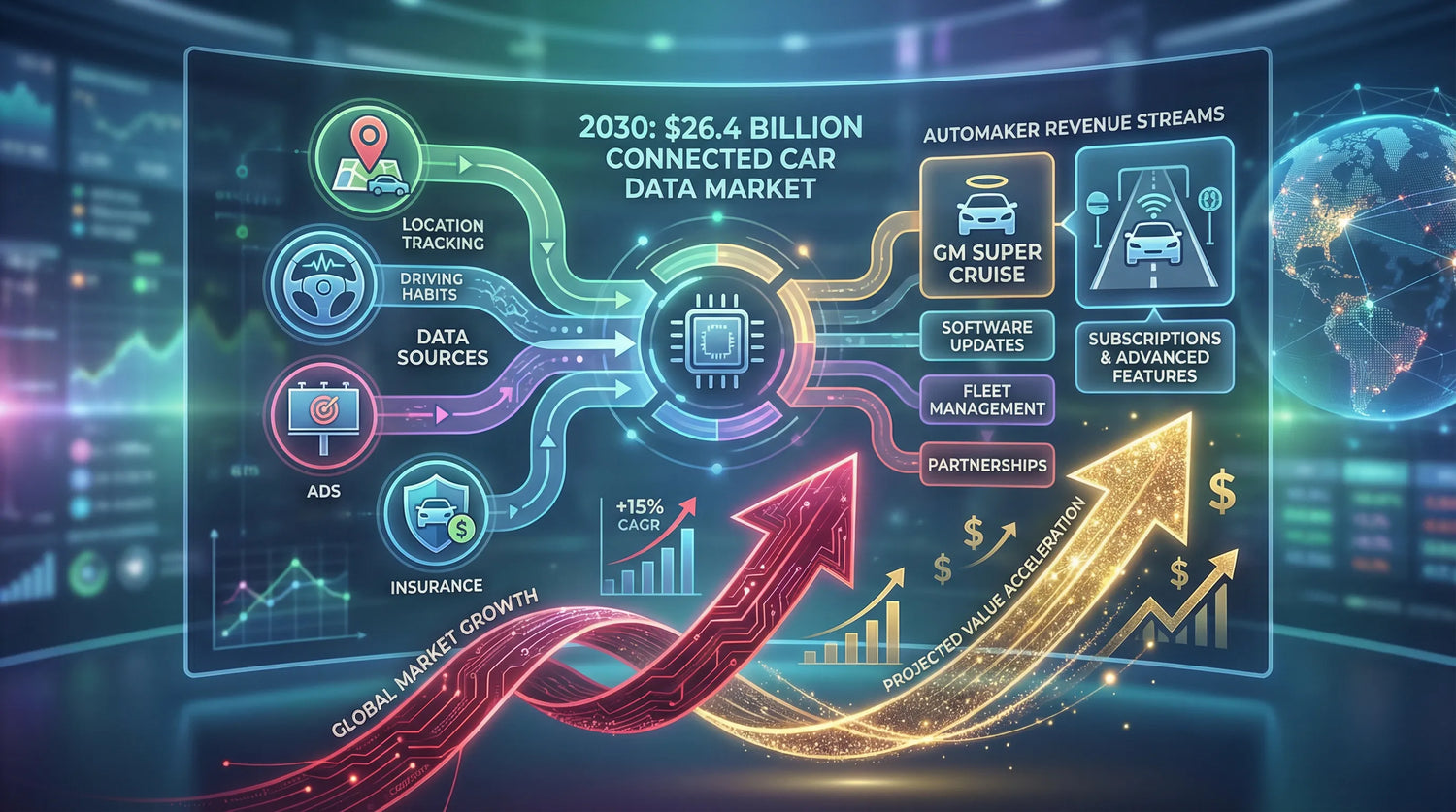
Quick Answer: Automakers like GM, Tesla, and Rivian are removing Apple CarPlay to control in-car data and drive subscription revenue. The connected car data market is projected to reach $26.4 billion by 2030, and every minute a driver spends in CarPlay is a minute the automaker can't monetize. GM alone earned $5.4 billion from connected services in 2025. CARLUEX AIR is one of the easiest ways to add wireless CarPlay. Browse CARLUEX wireless adapters to find the right fit for your car.
Over 80% of car buyers consider Apple CarPlay essential. Nearly half say they'd reject a vehicle entirely if it didn't offer the feature. Yet some of the world's largest automakers are actively ripping it out.
This isn't a technology problem. It's not about screen size, safety, or user experience — no matter what the press releases say. This is about data, subscriptions, and a connected car market projected to hit $26.4 billion by 2030. Every minute you spend inside CarPlay is a minute your automaker can't track your location, serve you ads, or sell your driving habits to an insurance company.
Here's exactly what's happening, who's behind it, and what you can do about it.
What About The CarPlay Exodus — Which Automakers Are Dropping It (And Which Aren't)?

The list of automakers walking away from CarPlay is growing. Some have dropped it quietly. Others have made it a headline. And a surprising number are refusing to adopt Apple's next-generation system before it even launches. Here's where every major brand stands right now.
GM's All-In Bet — From EVs to Every Vehicle

General Motors didn't just dip a toe in. It cannonballed. GM first removed Apple CarPlay and Android Auto from its electric vehicles — the Blazer EV, Equinox EV, and the electric Silverado. Then in late 2025, the company confirmed it would expand the removal to all future vehicles, including gas-powered models.
CEO Mary Barra offered a carefully worded explanation. She told reporters the existing CarPlay integration was "very clunky," "wasn't seamless," and "could be distracting." Sterling Anderson, GM's Chief Product Officer, suggested that drivers would prefer GM's larger built-in screens over phone projection for features like maps and Super Cruise.
But automotive journalists weren't buying it. As Motor1 put it, GM is "manufacturing a problem so it can sell a solution." The real motive, critics argue, is a cash grab — a move to monetize the data connection, control navigation, and paywall features that were previously free through CarPlay.
GM confirmed that existing gas-powered vehicles will continue to offer CarPlay "for the foreseeable future." But every new model rolling off the line is heading in one direction: away from Apple.
Tesla, Rivian, and the "Never Had It" Club

Tesla has never offered Apple CarPlay. Not once. From day one, the company built its own closed infotainment ecosystem and kept Apple at arm's length. The philosophy is simple: if Tesla controls the screen, Tesla controls the data.
Rivian followed the same playbook. Its R1S and R1T launched with a proprietary system and no CarPlay support. InsideEVs reviewed the Rivian infotainment system and concluded that while Apple Maps and Google Maps on CarPlay are still superior for navigation, the built-in system was good enough that "I didn't miss Apple CarPlay."
Interestingly, recent reports suggest Tesla is now developing standard CarPlay support — though notably not CarPlay Ultra, the deeper integration Apple wants. If true, it would be a remarkable reversal driven by one thing: customer demand.
The CarPlay Ultra Resistance — Mercedes, Audi, and Volvo Say No

Apple announced CarPlay Ultra — its next-generation system that takes over the entire dashboard, including the instrument cluster and climate controls — at WWDC 2022. It promised a 2024 launch. That deadline came and went.
In May 2025, Apple finally launched CarPlay Ultra with exactly one automaker: Aston Martin, available in the U.S. and Canada. Porsche — originally announced alongside Aston Martin — still hasn't shipped it. Ford is "evaluating." Hyundai is rumored to be interested.
But the real story is who said no. Mercedes-Benz, Audi, Volvo, and Polestar have all explicitly refused to adopt CarPlay Ultra. Their reasoning is blunt: they don't want Apple "invading their systems." Giving Apple control of the instrument cluster means giving Apple control of the driver's entire visual experience — and the data that comes with it.
Here's where every major automaker stands today:
| Automaker | Standard CarPlay | CarPlay Ultra | Status |
|---|---|---|---|
| GM (Chevy, Cadillac, GMC, Buick) | ❌ Removing | ❌ No | Dropping from all future vehicles |
| Tesla | ❌ Never offered | ❌ No | Developing standard CarPlay (unconfirmed) |
| Rivian | ❌ Never offered | ❌ No | Proprietary system only |
| Mercedes-Benz | ✅ Yes | ❌ Refused | Protecting MBUX system |
| Audi | ✅ Yes | ❌ Refused | Protecting MMI system |
| Volvo | ✅ Yes | ❌ Refused | Partnered with Google Built-In |
| Polestar | ✅ Yes | ❌ Refused | Partnered with Google Built-In |
| Aston Martin | ✅ Yes | ✅ First to launch | Live in U.S. & Canada (May 2025) |
| Porsche | ✅ Yes | ⏳ Delayed | Was promised 2024, still pending |
| Ford | ✅ Yes | ⏳ Evaluating | No commitment yet |
| Hyundai / Kia | ✅ Yes | ⏳ Rumored | Under evaluation |
| Toyota / Subaru | ✅ Yes | ❓ Unknown | Standard CarPlay supported |
| Honda | ✅ Yes | ❓ Unknown | Standard CarPlay supported |
If you're driving — or shopping for — a vehicle that's losing CarPlay support, aftermarket wireless adapters can restore the experience. CARLUEX offers a full lineup of adapters that bring wireless CarPlay and Android Auto back to vehicles where automakers have removed or never included it. It's worth knowing your options before the next model year arrives.
What About Follow the Money — The $26.4 Billion Data War Behind the Scenes?

Automakers aren't removing CarPlay because it's "clunky." They're removing it because it stands between them and billions of dollars in recurring revenue. To understand why, you need to follow the money.
The Connected Car Gold Rush — $26.4 Billion by 2030
According to MarketsandMarkets, the global connected car market was valued at $12.4 billion in 2024 and is projected to reach $26.4 billion by 2030, growing at a compound annual growth rate of 13.3%. That's not a niche market. That's a gold rush.
The revenue streams are diverse: over-the-air software updates, built-in navigation subscriptions, multimedia streaming, remote diagnostics, insurance telematics, and in-car commerce. Every one of these revenue streams depends on one thing — the automaker controlling the screen.
Here's the problem for automakers: when you use Apple CarPlay, your navigation data goes to Apple. Your music streaming data goes to Spotify or Apple Music. Your app usage data stays within Apple's ecosystem. The automaker gets almost nothing. Every minute you spend in CarPlay is a minute the automaker can't monetize. And at $26.4 billion, those minutes add up fast.
GM's $5.4 Billion Subscription Machine
The clearest proof that this is about money sits in GM's earnings report. In 2025, General Motors reported $5.4 billion in deferred revenue from OnStar and connected services — things like safety systems, in-car Wi-Fi, audio streaming, and app access. On top of that, Super Cruise — GM's hands-free driving subscription — hit 620,000+ subscribers with $234 million in revenue, an 80% year-over-year jump.
GM projects this will grow to $7.5 billion by 2026, with Super Cruise alone generating nearly $400 million. CFO Paul Jacobson told investors that "OnStar is laying the foundation for the software-defined vehicle."
Connect the dots. GM removes CarPlay. Users are forced into GM's built-in navigation, GM's streaming apps, GM's connected services. Those services generate subscription revenue. That revenue is growing at 80% per year. CarPlay was the obstacle. Removing it was the strategy.
While GM pushes users toward paid subscriptions, drivers don't have to accept it. A CARLUEX PRO+ adapter plugs directly into the vehicle's USB port and restores wireless CarPlay — no monthly fees, no subscriptions, no data harvesting. It's the kind of one-time purchase that automakers hope you'll never discover.
The Subscription Arms Race — Stellantis, BMW, and Ford's $50B+ Combined Bet
GM isn't alone. The entire industry is racing toward subscription revenue.
Stellantis — parent company of Jeep, Dodge, Ram, Chrysler, Fiat, Alfa Romeo, and Peugeot — announced a target of $22.5 billion in annual software and subscription revenue by 2030. The plan involves growing its connected vehicle fleet from 12 million to 34 million. CEO Carlos Tavares said software will "shift the center of gravity of our business," with profit margins comparable to a tech company rather than a traditional automaker.
BMW has already tested the waters — infamously charging drivers a monthly subscription to use their own heated seats. The backlash was fierce, but BMW's target remains: €5 billion in subscription revenue by 2030. The company plans to expand into performance upgrades, driver assistance features, and connected services.
Then there's Ford. While Ford's CEO has publicly said the company has "no plans" for subscription paywalls, Ford quietly patented an in-car advertising system that serves targeted ads on the infotainment screen — based on your destination, your driving patterns, and even conversations between passengers. The patent describes "listening to conversations between occupants in the vehicle" and parsing them "for keywords or phrases."
Add it up: GM's $7.5 billion projection, Stellantis's $22.5 billion target, BMW's €5 billion goal, and Ford's $20 billion market estimate. The combined industry bet on software and subscription revenue exceeds $50 billion. CarPlay stands directly in the way of all of it.
As automakers race to monetize every touchpoint, a device like the CARLUEX PRO+ 2.0 gives drivers a subscription-free alternative. It connects in seconds, works wirelessly, and keeps you inside Apple's ecosystem — where your data stays yours.
What About Your Data Behind the Wheel — What Automakers Actually Know About You?

The money is staggering. But the privacy implications are even more unsettling. When automakers talk about "connected services," they're talking about an unprecedented level of data collection — and most drivers have no idea how much their car knows about them.
The Mozilla Report — Cars Are the "Worst Category" for Privacy
In September 2023, the Mozilla Foundation published its "Privacy Not Included" report on connected cars. The conclusion was damning: cars are "the official worst category of products for privacy" that Mozilla has ever reviewed — worse than smart speakers, fitness trackers, or any other connected device.
The numbers are stark. 92% of automakers give drivers little or no control over their personal data. 84% share user data with outside parties. The types of data collected go far beyond what most people expect: biometric information, precise geolocation tracking, driving behavior patterns, video recordings, voice data, and even information about passengers.
This isn't hypothetical. It's happening right now, in the car sitting in your driveway.
From Your Steering Wheel to Your Insurance Bill
One of the most concrete — and alarming — examples of vehicle data monetization involves insurance. According to the Electronic Frontier Foundation, automakers collect "driving data" or "driver behavior information" that can be shared directly with insurance companies. Hard braking events, rapid acceleration, late-night driving, speed patterns — all of it can be transmitted without the driver's meaningful awareness.
GM's OnStar Smart Driver program became a flashpoint when reports revealed that driving behavior data was being shared with insurance data brokers like LexisNexis and Verisk, potentially affecting drivers' insurance premiums — sometimes without clear consent.
The FTC has warned that connected car data collection can "threaten consumers' privacy and financial welfare." The agency has highlighted risks including tracking visits to sensitive locations like medical clinics and places of worship, grouping consumers into sensitive categories for advertising, and monetizing personal information beyond what's needed to provide the requested service.
Here's the connection to CarPlay that most people miss: when you use CarPlay, your navigation and app data flows through Apple's privacy framework — not the automaker's data pipeline. Apple doesn't sell your location data to insurance companies. It doesn't parse your conversations for advertising keywords. Removing CarPlay doesn't just push you toward subscriptions. It pushes you toward a system that collects far more of your personal data.
Using CarPlay through a CARLUEX adapter means your navigation, music, and messaging data stays within Apple's ecosystem. It's a privacy choice as much as a convenience choice.
The Regulatory Pushback — FTC, EU Data Act, and What's Coming
Regulators are starting to catch up. The FTC has had connected cars on its radar since 2013, hosting workshops and publishing reports on data collection risks. In 2024, the agency issued its strongest statement yet, warning automakers that unlawful collection and use of connected car data will face enforcement action.
In Europe, the EU Data Act — with most obligations taking effect in September 2025 — goes further. It gives vehicle owners explicit rights to access the data their cars generate and even share it with third parties. By September 2026, connected vehicles sold in the EU must allow users to "easily, safely, and freely" access their data in a "structured, commonly used, and machine-readable format."
What does this mean for the CarPlay war? Regulation could force automakers to be more transparent about what they collect and how they use it. If consumers realize the full extent of in-car data harvesting, the demand for privacy-preserving alternatives — like CarPlay — could intensify. Some analysts believe regulation may eventually require automakers to offer third-party infotainment options rather than locking users into proprietary systems.
Until regulations fully catch up, consumers can take control today. Solutions like CARLUEX prioritize the user's ecosystem over the automaker's data pipeline — giving drivers a way to opt out of the surveillance economy without giving up the connected experience they want.
What You Can Do — Keeping CarPlay in Your Car?
Understanding the problem is one thing. Doing something about it is another. The good news: you have more options than automakers want you to think.
Vote with Your Wallet — Choosing CarPlay-Friendly Vehicles
The most powerful signal you can send is your purchase decision. A McKinsey Mobility Consumer Pulse survey found that roughly one-third of car buyers consider CarPlay or its Android equivalent a key factor in their purchase decision. Separate survey data suggests 45% of buyers would reject a vehicle that doesn't offer CarPlay.
Those numbers matter. Automakers watch purchase intent data obsessively. If enough buyers walk away from CarPlay-free vehicles, the financial calculus changes. Right now, the brands that still fully support standard CarPlay include Toyota, Honda, Hyundai, Kia, Ford, BMW (standard, not Ultra), and most mainstream Japanese and Korean manufacturers. Check Apple's official CarPlay compatibility list before you sign anything.
The Aftermarket Solution — Wireless CarPlay Adapters

If you already own a vehicle that's losing CarPlay — or you've fallen in love with a car that never had it — aftermarket adapters are the most practical solution available. These devices plug into your car's USB port and create a wireless bridge between your iPhone and the vehicle's infotainment screen using Bluetooth for initial pairing and 5GHz Wi-Fi for data transfer.
The market has exploded. You'll find dozens of brands on Amazon with names you've never heard of. Many look identical because they share the same underlying hardware. The differences come down to connection speed, stability under heat, software updates, and long-term reliability.
Basic adapters from brands like Carlinkit and Ottocast offer entry-level wireless conversion, typically in the $30–50 range. They get the job done for casual use, but users frequently report connection drops, slow reconnection times, and overheating during extended drives — especially in warmer climates.
CARLUEX takes a different approach with a tiered product lineup designed to match different needs and budgets:
- CARLUEX LINK ($59) — The entry point. Converts wired CarPlay and Android Auto to wireless with near-instant connection. Dual-platform support covers both iPhone and Android users. If you just want to cut the cord, this is the most affordable way to do it.
- CARLUEX GO ($109) — Adds built-in entertainment with pre-installed YouTube and Netflix, phone mirroring, and a 10-second boot time. The USB-A expansion port supports a Bluetooth remote for non-touchscreen vehicles — a detail most competitors overlook entirely.
-
CARLUEX AIR ($139) — Runs a full Android OS, turning your car's screen into a tablet. Download any app from the Play Store — TikTok, Disney+, Waze, local TV apps. It supports OTA firmware updates, so the device improves over time instead of becoming obsolete. For drivers who want maximum app compatibility, this is the sweet spot.
- CARLUEX PRO+ 2.0 ($269) — The latest generation. Upgraded processor, faster boot times, improved thermal design, and enhanced Bluetooth 5.2 for more stable wireless connections. For drivers who want the absolute best aftermarket CarPlay experience available today.
Every CARLUEX device above the LINK tier supports OTA updates — meaning you get new features and compatibility improvements without buying new hardware. That's a meaningful difference from budget adapters that ship once and never improve. You can check the latest firmware updates on the CARLUEX upgrade page.
For a deeper look at setup and daily use, CARLUEX has published detailed guides including how to set up a wireless adapter and how to stream Spotify through CarPlay.
Protecting Your Data — Practical Steps for Connected Car Owners
Whether or not you use an aftermarket adapter, there are concrete steps you can take to limit how much data your car collects and shares:
- Review your vehicle's privacy settings. Most connected cars have data-sharing toggles buried in the infotainment menu or the manufacturer's app. Find them. Turn off everything you don't explicitly need.
- Use CarPlay or Android Auto instead of built-in navigation. When you navigate through CarPlay, your route data stays with Apple — not with the automaker's data brokers. This is one of the simplest privacy wins available.
- Check what data your manufacturer has collected. The EFF has published a detailed guide on how to request your data from major automakers and opt out of sharing where possible.
- Opt out of telematics programs. Programs like GM's OnStar Smart Driver may share your driving behavior with insurance data brokers. You can usually opt out, but you have to actively do it — it's rarely the default.
- Wipe your data before selling your car. The FTC recommends treating your car like a computer: factory reset the infotainment system and deauthorize your accounts before transferring ownership.
By routing your navigation and media through CarPlay — whether factory-installed or via a CARLUEX adapter — you keep that data within Apple's privacy framework rather than the automaker's collection ecosystem. It's not a perfect solution to the broader privacy problem, but it's a meaningful step you can take today.
What About Frequently Asked Questions?
Why is GM getting rid of Apple CarPlay?
GM is removing Apple CarPlay from all future vehicles to drive users toward its proprietary infotainment system and subscription services. OnStar generated $5.4 billion in revenue in 2025, and Super Cruise subscriptions grew 80% year-over-year. By removing CarPlay, GM forces users into its own ecosystem where it can monetize navigation data, streaming services, and connected features through recurring subscriptions.
Which automakers still support Apple CarPlay in 2026?
As of 2026, Toyota, Honda, Hyundai, Kia, Ford, BMW, and most mainstream automakers still support standard CarPlay. GM is removing it from all future vehicles. Tesla and Rivian have never offered it. Mercedes, Audi, Volvo, and Polestar support standard CarPlay but are refusing Apple's next-generation CarPlay Ultra. Only Aston Martin has launched CarPlay Ultra so far.
Can I add CarPlay to a car that doesn't have it?
Yes. Aftermarket wireless CarPlay adapters like CARLUEX PRO+2.0 can add wireless CarPlay functionality to vehicles that have removed it or never offered it. These adapters plug into the car's USB port and use Bluetooth and Wi-Fi to deliver CarPlay through the existing display. Models range from basic wireless converters ($59) to full Android-based systems with 4G LTE connectivity ($168+).
Do automakers sell my driving data?
According to Mozilla's 2023 "Privacy Not Included" report, 84% of automakers share user data with outside parties. The FTC has warned that connected cars collect biometric, location, and driving behavior data that can affect insurance rates and be used for targeted advertising. Some automakers have shared driving data with insurance brokers like LexisNexis without clear driver consent.
What is CarPlay Ultra and why are automakers resisting it?
CarPlay Ultra is Apple's next-generation car interface announced at WWDC 2022. Unlike standard CarPlay, it takes over the entire dashboard — instrument cluster, climate controls, and all displays. Automakers like Mercedes, Audi, and Volvo resist it because it gives Apple unprecedented control over the in-car experience, threatening their ability to differentiate their brand and monetize connected services.
What About The Road Ahead?
The battle between automakers and Apple isn't going away. If anything, it's accelerating. As connected car revenue grows toward that $26.4 billion mark, the incentive to remove CarPlay only gets stronger. Regulation from the FTC and EU may eventually force more transparency, but that's a slow-moving process.
In the meantime, the power sits with consumers. Every purchase decision, every adapter installed, every opt-out from a telematics program sends a signal. Automakers are betting that convenience will win — that drivers will accept whatever system comes built into the dashboard. The question is whether enough drivers will push back to change the math.
If you want to keep CarPlay in your life regardless of what your automaker decides, explore the full CARLUEX lineup. From the $59 LINK to the flagship PRO+ 2.0, there's an option for every vehicle and every budget. Your car, your screen, your choice.


Zostaw komentarz
Wszystkie komentarze są moderowane przed opublikowaniem.
Ta strona jest chroniona przez hCaptcha i obowiązują na niej Polityka prywatności i Warunki korzystania z usługi serwisu hCaptcha.