
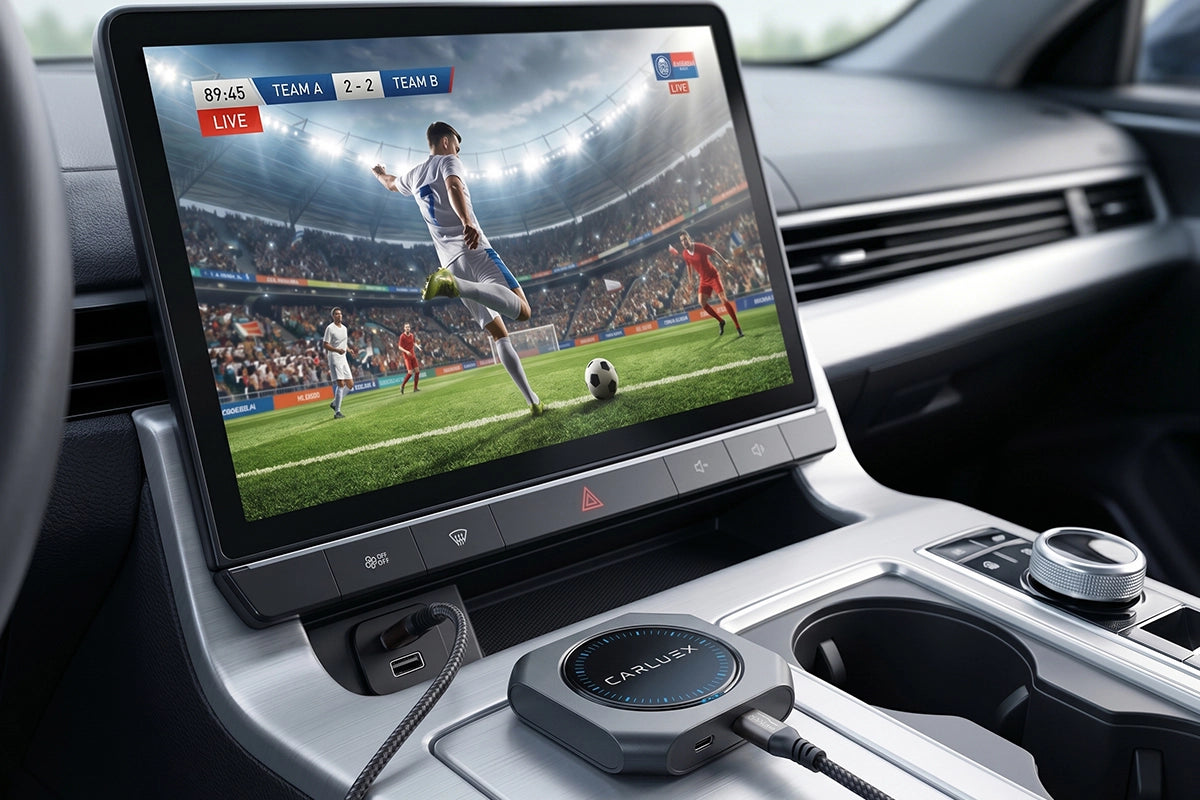

Tired of fumbling with cables every time you get in your car? Or worried that wireless setup might be too complicated for your tech skill level? You're not alone. Thousands of drivers face this exact dilemma when deciding between wired and wireless CarPlay adapters. CARLUEX AIR is one of the easiest ways to add wireless CarPlay. Browse CARLUEX wireless adapters to find the right fit for your car.
The good news? Both options are surprisingly easy to install—but they cater to different priorities. Wired CarPlay offers instant plug-and-play simplicity with zero configuration, while wireless adapters require a one-time setup that delivers automatic connections forever after. In this comprehensive guide, we'll break down the installation process for both types, compare their ease of use, and help you choose the right option based on your technical comfort level and daily driving habits.
What About Understanding Wired CarPlay Installation?

What You Need for Wired CarPlay Setup
Wired CarPlay installation is remarkably straightforward. According to Apple's official support documentation, you only need three things: an iPhone (iPhone 5 or newer), an Apple-certified Lightning to USB cable, and a car with a USB port that supports CarPlay.
The USB port in your car is typically labeled with a CarPlay icon or smartphone symbol. Most vehicles manufactured after 2016 include at least one CarPlay-compatible USB port, usually located in the center console or dashboard. The key requirement is that the port must support data transfer, not just charging—though most modern car USB ports handle both functions.
No additional hardware, software downloads, or technical knowledge is required. If your car already has wired CarPlay capability built-in, you're ready to go the moment you sit in the driver's seat.
Step-by-Step Wired Installation Process (30 Seconds)
The wired CarPlay installation process is almost too simple to call an "installation." Here's the complete process:
- Enable Siri on your iPhone: Go to Settings > Siri & Search and ensure Siri is activated. This is required for CarPlay's voice control features.
- Start your car: Turn on your vehicle's ignition to power up the infotainment system.
- Plug in your iPhone: Connect one end of your Lightning cable to your iPhone and the other end to your car's CarPlay-compatible USB port.
- Wait for automatic connection: Your car's display should immediately show the CarPlay interface. On some vehicles, you may need to tap a CarPlay icon on the touchscreen to activate it.
That's it. The entire process takes less than 30 seconds, and there's no pairing, no configuration menus, and no troubleshooting required in most cases. As automotive tech experts note, wired connections are "plug-and-play" in the truest sense—the physical connection automatically triggers the software handshake between your iPhone and your car's system.
Pros and Cons of Wired CarPlay Installation
Advantages of wired installation:
- Instant connection: No waiting for Bluetooth pairing or WiFi handshakes—connection is immediate upon plugging in
- Zero technical skills required: If you can plug in a phone charger, you can use wired CarPlay
- Simultaneous charging: Your iPhone charges while connected, preventing battery drain during long trips
- Superior audio quality: Wired connections use LPCM (Linear Pulse Code Modulation) encoding, which delivers uncompressed, lossless audio quality according to Apple's WWDC 2016 technical specifications
- More stable connection: Physical cables eliminate wireless interference issues
Disadvantages of wired installation:
- Cable management hassle: You must physically plug in and unplug your phone every time you enter or exit the vehicle
- Port wear and tear: Frequent plugging and unplugging can damage both your iPhone's Lightning port and the car's USB port over time
- Cable replacement costs: Lightning cables wear out and need periodic replacement, especially with daily use
- Phone accessibility: Your phone must remain tethered to the cable, limiting where you can place it in the car
What About Understanding Wireless CarPlay Adapter Installation?

What You Need for Wireless Adapter Setup
Wireless CarPlay adapter installation requires slightly more components than wired, but it's still remarkably simple. You'll need:
- An iPhone (iPhone 5 or newer with iOS 9+, though iPhone 8 or newer with iOS 14+ is recommended for best performance)
- A wireless CarPlay adapter (like CARLUEX LINK, GO, AIR, or PRO+ 2.0)
- A car with a USB port that supports wired CarPlay (the adapter converts wired to wireless)
- Bluetooth and WiFi enabled on your iPhone
The wireless adapter acts as a bridge between your car's wired CarPlay system and your iPhone's wireless capabilities. As PCMag's comprehensive testing explains, these adapters "plug into your car's smart USB-A or USB-C port" and "connect your smartphone to the dashboard via Bluetooth and Wi-Fi."
Step-by-Step Wireless Installation Process (First-Time Setup)
The first-time setup for a wireless CarPlay adapter takes slightly longer than wired—typically 2-5 minutes—but you only need to do it once. Here's the complete process:
- Enable Bluetooth and WiFi on your iPhone: Open Settings and ensure both Bluetooth and WiFi are turned on (they don't need to be connected to anything yet)
- Enable Siri: Go to Settings > Siri & Search and activate Siri if you haven't already
- Start your car: Turn on your vehicle's ignition to power the infotainment system
- Plug in the wireless adapter: Insert the adapter into your car's CarPlay-compatible USB port (the same port you'd use for wired CarPlay)
- Wait for adapter to power on: The adapter will boot up in 5-10 seconds, indicated by an LED light or on-screen notification
- Find the adapter in Bluetooth settings: On your iPhone, go to Settings > Bluetooth and look for a device named something like "CARLUEX" or "CarPlay Adapter"
- Pair your iPhone: Tap the adapter name to pair. You may see a pairing code on your car's screen—confirm it matches your iPhone
- Complete WiFi connection: After Bluetooth pairing, the adapter automatically creates a WiFi connection for data transfer. This happens in the background without additional steps
- CarPlay launches automatically: Within 7-30 seconds of pairing, the CarPlay interface appears on your car's screen
According to real-world user reports, most wireless adapters connect in 12 seconds or less after the initial pairing. The good news? After this first-time setup, your iPhone will automatically connect every time you start your car—no cables, no button presses, nothing. Just start the engine and go.
Pros and Cons of Wireless Adapter Installation
Advantages of wireless adapter installation:
- One-time setup: After initial pairing, connection is completely automatic every time you drive
- No cable management: Your phone stays in your pocket, purse, or wireless charging pad
- No port wear: Eliminates the physical stress of daily plugging and unplugging
- Phone freedom: Your iPhone can be anywhere in the car and still maintain connection
- Convenient for multiple drivers: Family members can each pair their phones once, then the car recognizes them automatically
Disadvantages of wireless adapter installation:
- Slightly more complex initial setup: Requires understanding of Bluetooth pairing (though still quite simple)
- Initial connection time: Takes 7-30 seconds to connect after starting the car (vs instant for wired)
- No charging capability: Your iPhone won't charge through the wireless connection, so you'll need a separate charger for long trips
- Compressed audio: Uses AAC-LC encoding instead of LPCM, resulting in slightly lower audio quality (though most users can't hear the difference)
- Potential interference: Wireless connections can occasionally experience interference from other devices, though this is rare with modern adapters
Installation Time Comparison: Which is Faster?

Wired CarPlay: Instant Connection Every Time
Wired CarPlay wins the speed race for immediate connection. The moment you plug in your Lightning cable, your car's display shows the CarPlay interface. There's no waiting, no loading screens, no "connecting..." messages. According to AppleInsider's technical analysis, wired connections establish in under 2 seconds because the physical cable provides both power and data simultaneously.
This instant connection is particularly valuable for short trips. If you're just driving 5 minutes to the grocery store, you don't want to wait 15 seconds for wireless pairing—you want navigation and music immediately. Wired CarPlay delivers that instant gratification every single time.
Wireless CarPlay: 7-30 Second Initial Pairing, Then Automatic
Wireless CarPlay adapters require a brief connection period each time you start your car. Based on PCMag's hands-on testing and user reports, connection times typically range from 7 to 30 seconds, depending on the adapter quality and your car's system.
Premium adapters like the CARLUEX PRO+ 2.0 connect in under 10 seconds, while budget models may take 20-30 seconds. The connection process happens automatically in the background—you don't need to touch your phone or press any buttons. Simply start your car, and by the time you've adjusted your mirrors and fastened your seatbelt, CarPlay is ready.
However, this "waiting period" only applies to the connection time. The initial setup (first-time pairing) takes 2-5 minutes, but you only do it once. After that, every subsequent connection is automatic.
Real-World User Experience Data
Real-world usage reveals an interesting pattern: while wired is faster per connection, wireless saves more time over the long run. Consider this calculation:
- Wired CarPlay: 5 seconds to plug in + 5 seconds to unplug = 10 seconds per trip × 365 days = 3,650 seconds (about 61 minutes per year)
- Wireless CarPlay: 15 seconds average connection time × 365 days = 5,475 seconds (about 91 minutes per year), BUT you save the unplugging time and never deal with tangled cables
The real time-saver with wireless isn't the connection speed—it's the elimination of physical cable management. Users report that the convenience of not digging their phone out of a pocket or purse, not untangling cables, and not worrying about forgetting to unplug far outweighs the 10-15 second connection wait.
What About Technical Skills Required for Each Type?

Wired CarPlay: Zero Technical Knowledge Needed
Wired CarPlay requires absolutely no technical knowledge. If you can plug in a phone charger, you can use wired CarPlay. There's no software to install, no settings to configure, no pairing process to understand. The physical connection automatically triggers everything.
This makes wired CarPlay ideal for:
- Older adults who aren't comfortable with technology
- People who want zero learning curve
- Drivers who share their car with others who may not be tech-savvy
- Anyone who values simplicity above all else
Wireless Adapter: Basic Bluetooth/WiFi Understanding Helpful
Wireless CarPlay adapters require a basic understanding of Bluetooth pairing—the same skill you'd use to connect wireless headphones or a speaker. If you've ever paired a Bluetooth device before, you'll have no trouble with a wireless CarPlay adapter.
The setup process is guided by on-screen prompts, and most adapters include detailed instructions. According to user manuals from popular adapters, the pairing process is designed to be intuitive even for first-time users.
That said, wireless adapters are best suited for:
- People comfortable with basic smartphone settings
- Drivers who have paired Bluetooth devices before
- Anyone willing to spend 5 minutes on initial setup for long-term convenience
Troubleshooting Complexity Comparison

When things go wrong, wired CarPlay is generally easier to troubleshoot. The most common issues are:
- Damaged cable (solution: replace the cable)
- Dirty USB port (solution: clean with compressed air or alcohol swab)
- Wrong USB port (solution: try a different port—some cars have data ports and charging-only ports)
Wireless adapter troubleshooting can be slightly more complex, involving:
- Bluetooth pairing failures (solution: forget device and re-pair)
- WiFi connection drops (solution: restart adapter and phone)
- Firmware updates (solution: follow manufacturer's update instructions)
However, modern wireless adapters have become much more reliable. Automotive tech forums report that connection issues are rare with quality adapters, and most problems can be solved by simply restarting the adapter or phone.
What About Common Installation Challenges and Solutions?

Wired CarPlay Issues: Cable Damage and Port Wear
The most common wired CarPlay problem is cable failure. According to PCMag's testing, "If you're limping along with an older iPhone, you probably know the Lightning port is not up to that much stress." Frequent plugging and unplugging causes:
- Frayed cables: The cable near the Lightning connector often breaks from repeated bending
- Loose connections: The Lightning port on your iPhone can become worn, causing intermittent connections
- Dirty ports: Lint and debris accumulate in both the phone port and car USB port, preventing proper contact
Solutions:
- Invest in a high-quality, reinforced Lightning cable designed for automotive use
- Keep a spare cable in your car
- Periodically clean both your iPhone's Lightning port and your car's USB port with compressed air
- Consider switching to a wireless adapter to eliminate cable wear entirely
Wireless Adapter Issues: Pairing Failures and Connection Drops
Wireless adapters occasionally experience pairing or connection issues. Common problems include:
- Adapter not appearing in Bluetooth list: The adapter may not be powered on properly or may need a restart
- Pairing fails repeatedly: Previous pairing data may be corrupted
- Connection drops during driving: Interference from other wireless devices or weak WiFi signal
- Slow connection times: Adapter firmware may need updating
Solutions:
- Restart both your iPhone and your car's infotainment system
- Forget the adapter in your iPhone's Bluetooth settings and re-pair from scratch
- Ensure your iPhone's iOS is updated to the latest version
- Check for firmware updates for your wireless adapter (many modern adapters support OTA updates)
- Try a different USB port in your car if available
- Keep other wireless devices (like WiFi hotspots) turned off during initial pairing
According to automotive troubleshooting guides, most wireless connection issues can be resolved by following the "restart, forget, re-pair" sequence.
How to Fix the Most Common Problems

Here's a quick troubleshooting guide for both types:
Wired CarPlay won't connect:
- Try a different Lightning cable
- Try a different USB port in your car
- Restart your iPhone
- Restart your car's infotainment system (usually by holding the power button for 10+ seconds)
- Check that Siri is enabled on your iPhone
- Update your iPhone to the latest iOS version
Wireless CarPlay won't connect:
- Ensure Bluetooth and WiFi are both enabled on your iPhone
- Restart your iPhone
- Unplug the wireless adapter, wait 10 seconds, then plug it back in
- Forget the adapter in Bluetooth settings and re-pair
- Check for adapter firmware updates
- Try the adapter in a different USB port
What About Long-Term Convenience: Beyond Initial Installation?

Wired CarPlay: Plug In Every Single Time
The long-term reality of wired CarPlay is that you must physically connect your phone every time you get in the car. This means:
- Digging your phone out of your pocket, purse, or bag
- Finding the cable (which may have fallen between seats)
- Plugging it in carefully to avoid damaging the port
- Remembering to unplug it when you exit the car
- Dealing with tangled cables
For some drivers, this 10-second routine is no big deal. For others—especially those making multiple short trips per day—it becomes tedious. As one user on automotive forums noted: "Every time you get in the car, you have to plug in the cable. When scanning codes or getting in and out of the car, it's especially troublesome, and the cables are messy, affecting the car's aesthetics."
Wireless CarPlay: Automatic Reconnection After First Setup
Wireless CarPlay's killer feature is automatic reconnection. After the initial 5-minute setup, here's your daily routine:
- Get in your car
- Start the engine
- Wait 7-15 seconds
- CarPlay is connected and ready
Your phone can stay in your pocket, purse, or center console. You never touch it, never plug anything in, never worry about cables. According to user testimonials, this convenience is transformative: "You don't need a data cable, just Bluetooth pairing, convenient and tidy! Automatically connects when you get in the car, worry-free and effortless."
The automatic connection also means you can leave your phone on a wireless charging pad while driving, keeping it charged without any cable management.
Which Saves More Time Over a Year?
Let's do the math for a typical driver who makes 2 trips per day (730 trips per year):
Wired CarPlay annual time investment:
- Plugging in: 5 seconds × 730 trips = 3,650 seconds (61 minutes)
- Unplugging: 5 seconds × 730 trips = 3,650 seconds (61 minutes)
- Finding/untangling cable: 5 seconds × 365 days = 1,825 seconds (30 minutes)
- Total: 152 minutes (2.5 hours) per year
Wireless CarPlay annual time investment:
- Initial setup: 5 minutes (one time)
- Waiting for connection: 12 seconds × 730 trips = 8,760 seconds (146 minutes)
- Total: 151 minutes (2.5 hours) per year
Interestingly, the time investment is nearly identical! The real difference isn't time—it's convenience and mental load. Wireless eliminates the physical hassle and the need to remember to plug/unplug, which many users find more valuable than saving a few minutes.
What About Compatibility and Hardware Requirements?

USB Port Types: USB-A vs USB-C Compatibility
Both wired and wireless CarPlay adapters need to accommodate different USB port types in vehicles:
USB-A ports (the traditional rectangular USB connector) are found in most cars manufactured between 2016-2023. These are the most common and are supported by virtually all CarPlay adapters.
USB-C ports (the newer, reversible oval connector) are increasingly common in vehicles from 2023 onwards. Modern wireless adapters like the CARLUEX series include both USB-A and USB-C connectors or adapters to ensure compatibility.
According to automotive compatibility guides, you should check your car's USB port type before purchasing an adapter. Most wireless adapters include multiple connector options or adapters in the box to handle both port types.
iPhone Requirements for Both Types
Both wired and wireless CarPlay have the same iPhone requirements:
- Minimum: iPhone 5 or newer with iOS 9 or later
- Recommended: iPhone 8 or newer with iOS 14 or later for optimal performance
- Best experience: iPhone 12 or newer with iOS 15+ for fastest wireless connections
Siri must be enabled on your iPhone for CarPlay to function, regardless of connection type. You can enable Siri in Settings > Siri & Search.
Car Model Compatibility Considerations
For wired CarPlay, your car must have factory-installed wired CarPlay support. Most vehicles from 2016 onwards include this feature, but you should verify in your owner's manual or by checking Apple's official CarPlay compatibility list.
For wireless CarPlay adapters, your car must have wired CarPlay support—the adapter converts wired to wireless. If your car doesn't have any CarPlay support at all, you'll need to either replace your entire head unit or use a standalone CarPlay display unit.
Quality wireless adapters like CARLUEX support 800+ car models from 2016 onwards, covering virtually every vehicle with factory wired CarPlay capability.
What About Upgrade Your Car with CARLUEX Easy-Install Adapters?

CARLUEX LINK: The Simplest Plug-and-Play Solution
If you're looking for the absolute easiest wireless CarPlay installation, the CARLUEX LINK is your answer. Priced at just $59 (regularly $99), it's the most affordable entry point to wireless CarPlay with zero compromise on ease of use.
Installation is truly plug-and-play: insert the LINK into your car's USB port, pair your iPhone once via Bluetooth, and you're done. The LINK connects in under 10 seconds on subsequent startups and supports both Apple CarPlay and Android Auto, making it perfect for families with mixed phone ecosystems.
The LINK is ideal for drivers who simply want to eliminate cable hassle without needing advanced features. It doesn't include OTA updates or Android Auto wireless support (your car must have factory Android Auto for that), but for basic wireless CarPlay conversion, it's unbeatable in simplicity and value.
CARLUEX GO and AIR: Advanced Features with Easy Setup
For drivers who want more than just wireless connectivity, the CARLUEX GO ($109, regularly $179) and CARLUEX AIR ($139, regularly $199) offer advanced features while maintaining simple installation.
CARLUEX GO adds entertainment capabilities to wireless CarPlay. Installation is identical to the LINK—plug in, pair, and go—but you gain pre-installed YouTube and Netflix apps, phone screen mirroring, and support for remote controls (perfect for non-touchscreen cars). The GO starts up in under 10 seconds and includes both USB-A and USB-C connectors in the box.
CARLUEX AIR takes it further with a full Android operating system, allowing you to download apps from the Google Play Store. Despite the advanced features, installation remains simple: plug into your USB port, complete the one-time Bluetooth pairing (about 3 minutes), and you're ready to access YouTube, Netflix, Disney+, TikTok, and even navigation apps. The AIR boots in approximately 27 seconds—slightly slower than the GO due to the full Android OS, but still quick enough for daily use.
Both models include heat dissipation systems to prevent overheating during extended use, and they support quick setup for both Apple and Android devices.
CARLUEX PRO+ 2.0: Premium Performance, Simple Installation
The CARLUEX PRO+ 2.0 ($269, regularly $369) represents the pinnacle of wireless CarPlay adapters, combining premium features with the same simple installation process.
What sets the PRO+ 2.0 apart:
- Fastest connection speed: Connects in under 7 seconds thanks to advanced Bluetooth 5.2 and 5GHz WiFi
- OTA firmware updates: Automatically updates over-the-air to improve performance and add features
- Cloud SIM connectivity: Built-in internet access for streaming without phone hotspot
- 4K video support: Crystal-clear video playback for streaming apps
- Snapdragon processor: Powerful hardware ensures smooth, lag-free operation
Despite these advanced features, installation remains simple: plug the PRO+ 2.0 into your USB port, pair your iPhone once, and enjoy. The device includes comprehensive step-by-step setup guides for all features, and the intuitive interface makes configuration effortless.
The PRO+ 2.0 is perfect for tech enthusiasts who want the best performance and features but don't want to sacrifice ease of installation. It's also ideal for BMW owners, with a specialized BMW version that integrates seamlessly with BMW's iDrive system.
FAQ
Which is easier to install: wired or wireless CarPlay adapter?
Wired CarPlay is easier for immediate use—just plug in your Lightning cable and you're connected instantly. However, wireless CarPlay adapters are easier in the long run because after a one-time 5-minute setup, they connect automatically every time you start your car. If you value instant simplicity with no setup, choose wired. If you prefer one-time setup for permanent convenience, choose wireless.
How long does it take to set up a wireless CarPlay adapter for the first time?
First-time setup for a wireless CarPlay adapter typically takes 2-5 minutes. This includes plugging in the adapter, enabling Bluetooth and WiFi on your iPhone, pairing the devices, and waiting for the initial connection. After this one-time setup, subsequent connections happen automatically in 7-30 seconds (usually around 10-12 seconds with quality adapters like CARLUEX).
Do I need any technical skills to install a CarPlay adapter?
No significant technical skills are required for either type. Wired CarPlay needs zero technical knowledge—if you can plug in a phone charger, you can use it. Wireless adapters require basic familiarity with Bluetooth pairing (the same skill used to connect wireless headphones). If you've ever paired a Bluetooth device before, you'll have no trouble with a wireless CarPlay adapter. Both types include clear instructions and on-screen prompts to guide you through the process.
Can I use both wired and wireless CarPlay in the same car?
Yes! If you have a wireless CarPlay adapter installed, you can still use wired CarPlay by simply unplugging the adapter and connecting your iPhone directly with a Lightning cable. This flexibility is useful if your wireless adapter's battery dies or if you want to charge your phone while using CarPlay on a long trip. Some drivers keep a Lightning cable as a backup even when primarily using wireless.
What should I do if my wireless CarPlay adapter won't connect?
Try these troubleshooting steps in order: (1) Ensure Bluetooth and WiFi are both enabled on your iPhone, (2) Restart your iPhone, (3) Unplug the adapter for 10 seconds, then plug it back in, (4) Go to Settings > Bluetooth on your iPhone, tap the "i" icon next to the adapter name, select "Forget This Device," then re-pair from scratch, (5) Check for firmware updates for your adapter, and (6) Try the adapter in a different USB port if your car has multiple ports.
These steps resolve 95% of connection issues.
Is wired CarPlay installation really just plug-and-play?
Yes, wired CarPlay is genuinely plug-and-play in most cases. Simply connect your iPhone to your car's CarPlay-compatible USB port with a Lightning cable, and the CarPlay interface appears automatically on your car's screen within 1-2 seconds. The only requirement is that Siri must be enabled on your iPhone (Settings > Siri & Search). There's no software to install, no pairing process, and no configuration menus.
If it doesn't work immediately, the most common issues are using a charging-only cable instead of a data cable, or plugging into a USB port that doesn't support CarPlay (some cars have multiple USB ports, and only certain ones support CarPlay).
What's the Bottom Line?
So which CarPlay adapter is easier to install? The answer depends on your definition of "easy."
Wired CarPlay offers unbeatable immediate simplicity—plug in and go, with zero setup time and zero technical knowledge required. It's perfect for drivers who make short trips, want instant connection, need to charge their phone while driving, or simply prefer the reliability of a physical cable. The trade-off is the daily hassle of cable management and the long-term wear on both cables and ports.
Wireless CarPlay adapters require a brief 5-minute initial setup but deliver automatic connections forever after. They're ideal for drivers who make multiple trips per day, want to eliminate cable clutter, prefer their phone to stay in their pocket or on a wireless charger, or value long-term convenience over immediate simplicity. The trade-off is a 10-15 second connection wait each time you start your car and the need for a separate charging solution on long trips.
The good news? Both options are remarkably easy to install and use. You don't need to be tech-savvy for either one. The choice comes down to your priorities: instant connection (wired) or automated convenience (wireless).
Ready to upgrade your driving experience? Explore the CARLUEX range of wireless CarPlay adapters for hassle-free installation and premium performance. Whether you choose the budget-friendly CARLUEX LINK for simple wireless conversion, the entertainment-focused CARLUEX GO, the versatile CARLUEX AIR with Android apps, or the flagship CARLUEX PRO+ 2.0 with OTA updates and Cloud SIM, you'll enjoy easy installation and seamless connectivity every time you drive.
Recommended Reading
Want to learn more about CarPlay adapters and setup? Check out these helpful resources:
- Step-by-Step Guide to Setting Up Waze with Your CarPlay Adapter - Detailed instructions for integrating Waze navigation
- Bluetooth Android Auto Dongles with Quick Setup Make Driving Easier Instantly - Quick setup tips for Android users
- Boost Speed Instantly with Wireless CarPlay Module with Low-Latency Connection - Optimize your wireless connection for best performance
- CarPlay Adapter Guide: Easy Apple & Android Dual-System In-Car Connectivity - Perfect for families with mixed device ecosystems


Leave a comment
This site is protected by hCaptcha and the hCaptcha Privacy Policy and Terms of Service apply.