


Mercedes Holographic Windshield Display: What the Research Concept Means
Mercedes-Benz's holographic windshield display is a research concept, not a feature US buyers can order today. In a November 3, 2026 research update, the Mercedes-Benz USA Media Newsroom described a projector in the instrument panel sending content to transparent holographic film laminated into the windshield. The same source explicitly says the technology remains under development and is not a series-production announcement.
That distinction matters. The release offers a useful look at how a future windshield could become an information surface, but it does not name a production model, trim, price, launch date, final interface, regulatory approval, or market availability. This guide separates what Mercedes-Benz actually says from what still needs proof.
Mercedes holographic display at a glance
The official description is specific enough to explain the idea at a high level, yet deliberately stops short of a product specification. Here is the cleanest way to read the announcement.
| Mercedes-Benz says | Mercedes-Benz has not announced |
|---|---|
| A projector can send content toward transparent holographic film in the windshield. | A production vehicle, trim, option code, or sale date. |
| Holographic optical elements can reflect selected wavelengths. | Final resolution, brightness, field of view, power use, or repair procedure. |
| Content can remain visible in sunlight and be directed to specific viewing angles. | Final safety certification, legal approval, or market-by-market rules. |
| Potential examples include navigation, driving information, points of interest, video calls, and films. | Apple CarPlay, Android Auto, app support, or aftermarket-adapter compatibility. |
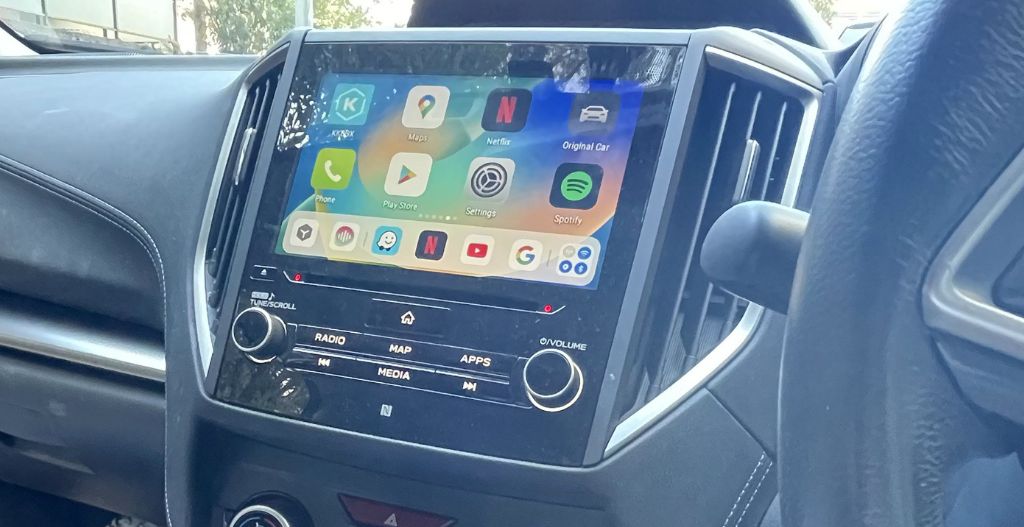
The image below is a generic illustration from CARLUEX's Shopify Files library. It helps show today's familiar center-screen layout; it is not a photo of Mercedes-Benz's prototype and does not prove any production equipment.

How the holographic windshield concept works
Mercedes-Benz describes two main components. First, a projector sits in the instrument panel. Second, a transparent film containing holographic optical elements is laminated into the windshield. The projector sends the image toward that film instead of relying on a conventional opaque screen.
According to the release, the optical elements reflect selected wavelengths. Mercedes-Benz says this approach can keep projected content visible in sunlight while the rest of the windshield remains transparent. The public page does not provide enough engineering detail to judge resolution, optical efficiency, heat performance, durability, replacement cost, or how the system behaves across all lighting and weather conditions.
This generic touchscreen image is included only to make the display-location contrast easier to understand. A center touchscreen is a physical panel; the Mercedes-Benz concept explores content appearing on a transparent windshield area.

Viewing angles are part of the concept
Mercedes-Benz also says content can be restricted to specific viewing angles. In the example given, information intended for the passenger would not be visible to the driver, and vice versa. That is an important research claim, but it is not yet a finalized privacy, comfort, or safety specification. Real-world performance would still need to account for seating position, driver height, windshield geometry, bright light, eyewear, and other production variables.
What Mercedes says the surface could show
The release lists several possible uses: contextual points of interest, navigation, driving information, video calls, and films. The word possible is essential. These are examples of what the research surface might present, not a confirmed app catalog or a promise that every type of content would be available to every occupant while the vehicle is moving.
A viewing-angle-controlled surface could, in principle, divide information by occupant. The driver might receive concise driving context while the passenger sees different content. Mercedes-Benz has not published a final interface, interaction method, distraction-management logic, or production operating rules for this concept.
The illustration below shows why position and viewing angle matter in any in-car display discussion. It is not a Mercedes-Benz vehicle or a representation of the optical film.

LED-in-glass and holographic projection are separate projects
The same Mercedes-Benz release discusses an intelligent display-in-glass project. In that concept, LED display elements are laminated into vehicle glass and are nearly invisible when inactive. Mercedes-Benz gives warning symbols and traffic information as potential examples.
That is different from the holographic windshield concept. The LED project embeds light-emitting elements in the glass; the holographic project uses a projector and transparent optical film. Both explore vehicle glass as an information surface, but one should not be used as proof of the other's capabilities, readiness, or production path.
The North American context also needs care. The Mercedes-Benz Group page for Research & Development North America says MBRDNA works on in-car user experiences and vehicle development and certification for US and global markets. That supports the broader US research context; it does not establish that MBRDNA created this particular holographic concept.
How this differs from today's infotainment and phone projection
A windshield display surface and an infotainment head unit answer different questions. The display surface concerns where visual information appears. A head unit concerns computing, software, connectivity, audio, inputs, vehicle integration, and supported services. A future vehicle could combine several display surfaces with one or more computing systems, but the research release does not define that architecture.
The announcement does not mention Apple CarPlay or Android Auto. It therefore cannot establish whether the concept would mirror phone-projection content, run native vehicle apps, use a separate passenger interface, or combine those approaches. It also cannot establish support for any external adapter.
This generic navigation image illustrates a current dashboard information surface. It is not a production Mercedes-Benz holographic display and should not be read as a compatibility example.

Why this guide does not recommend an adapter
This article does not recommend a CARLUEX product for the Mercedes-Benz research concept or for any Mercedes-Benz model. Only if a different vehicle has independently verified factory wired CarPlay should a reader use the CARLUEX PRO+ 2.0 specification page, compatible-vehicles reference, and compatibility-check guidance to evaluate that separate question. Those links are conditional references, not proof of fit for a holographic windshield system.
What US shoppers should verify if the technology reaches production
If Mercedes-Benz later announces a production application, verify the exact model year, US trim, installed options, and owner documentation rather than carrying assumptions forward from this research page. A concept description can change substantially before any customer-facing release.
- Model and market: look for a US-specific vehicle page, build sheet, or owner's manual naming the feature.
- Display zones: confirm which windshield areas are used and what the driver and passenger can see.
- Operating conditions: check restrictions for motion, parked use, video, calls, navigation, and passenger content.
- Hardware and repair: verify windshield replacement, calibration, projector servicing, tint, coating, and eyewear guidance.
- Connectivity: treat CarPlay, Android Auto, native apps, subscriptions, and data requirements as separate specifications.
NHTSA's visual-manual driver-distraction guidance treats communications, entertainment, information-gathering, and navigation interactions as secondary tasks. That general framework is useful when reading any future display announcement, but it is not an approval or evaluation of this Mercedes-Benz concept.
NHTSA also advises consumers to understand the exact technologies in a vehicle and consult its owner documentation in its driver-assistance technology guidance. The same verification habit is sensible for a future windshield display: the production manual and vehicle-specific documentation would matter more than a research preview.
Frequently asked questions
Is Mercedes' holographic windshield display available now?
No current availability is announced in the official source used here. Mercedes-Benz calls it a project under development and says the research update is not a customer-facing feature or series-production announcement.
Is this the same as a conventional head-up display?
Both place information in or near the driver's forward view, but the source describes a specific research setup using a projector and transparent holographic film. It does not provide a production specification that would justify treating it as identical to any current head-up display.
Can the driver and passenger see different content?
Mercedes-Benz says the concept can direct content to specific viewing angles so driver and passenger views may be separated. This remains a research claim, not a finalized performance guarantee.
Will it support Apple CarPlay or Android Auto?
The announcement does not say. A display concept alone does not prove phone-projection support, and no such compatibility should be inferred until a production vehicle's official specifications name it.
Does the concept need a CARLUEX adapter?
There is no evidence for that conclusion. The source does not describe a production head unit, factory wired CarPlay, or any CARLUEX compatibility. This guide therefore keeps product CTA disabled.
Related CARLUEX guides
- 2027 Mercedes C-Class infotainment: a production-model verification example
- Porsche PCM and Android Auto: separating system facts from assumptions
- Google Play in cars: Google built-in and phone projection are different


Zanechať komentár
Táto lokalita je chránená testom reCAPTCHA a vzťahujú sa na ňu pravidlá ochrany súkromia a podmienky poskytovania služby hCaptcha.